Loading pressure important in rod coating operations
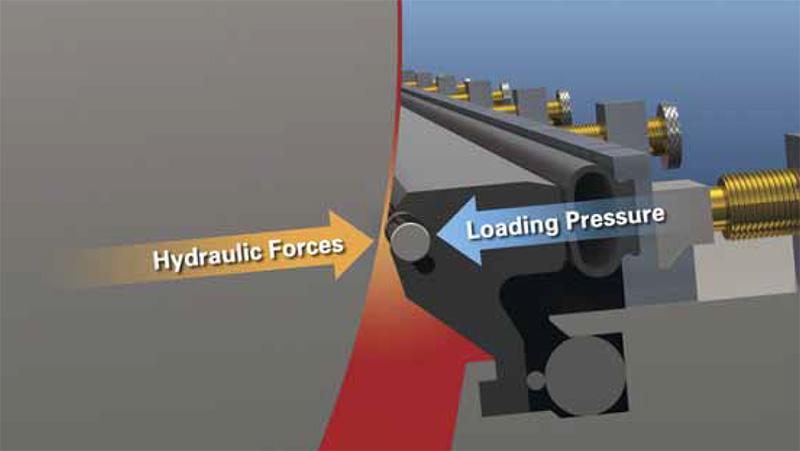
Loading pressure is an aspect of metering rod coating that can have a significant impact on the efficiency, quality and profitability of a mill’s coating operation. When loading pressure is not properly calibrated, many costly coating issues can arise.
Loading pressure is the force at the interface of the metering rod and the substrate being coated.
In converting applications, where the metering rod is coating directly onto the web with no backing roll, loading pressure is controlled through wrap angle and web tension. As the wrap angle or web tension increases, so does the loading pressure.
In higher-speed coating, usually when utilizing a backing roll or transfer roll, a pressure member (usually called a loading hose or loading tube) is used to control this force.
Here’s how loading pressure problems can impact rod coating operations in a mill – and profitability
Loading Pressure Affects Coat Weight
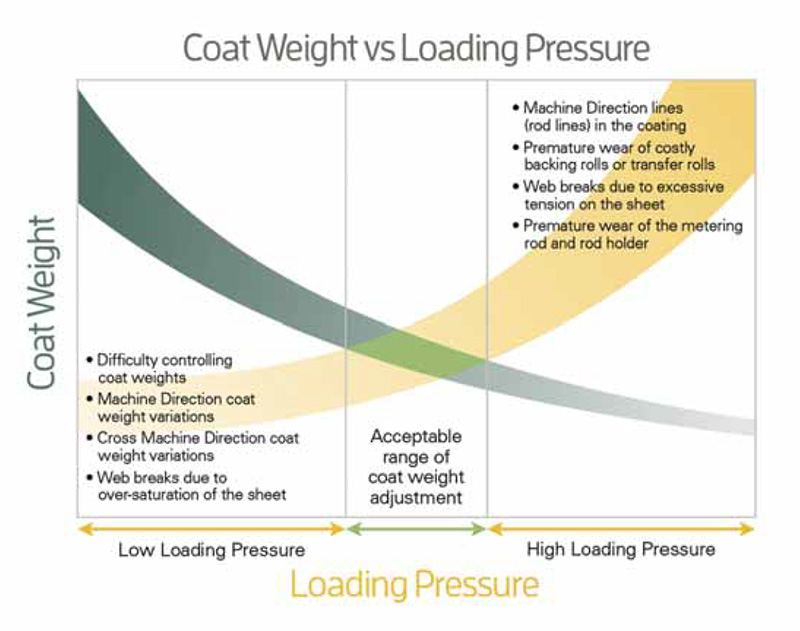
There is an inverse correlation between loading pressure
and coat weight. As loading
pressure increases, the coat
weight will decrease and vice
versa.
There are two main factors at work that create this relationship: hydraulic forces and effective thread volume. During coating, the wedge of coating being driven into the rod by the moving substrate imparts a hydraulic force on the rod, lifting it away from the substrate. Line speed, coating viscosity, and other factors affect this hydraulic force. But regardless of the source, loading pressure is used to counteract these forces and create a balance where target coat weights are achieved.
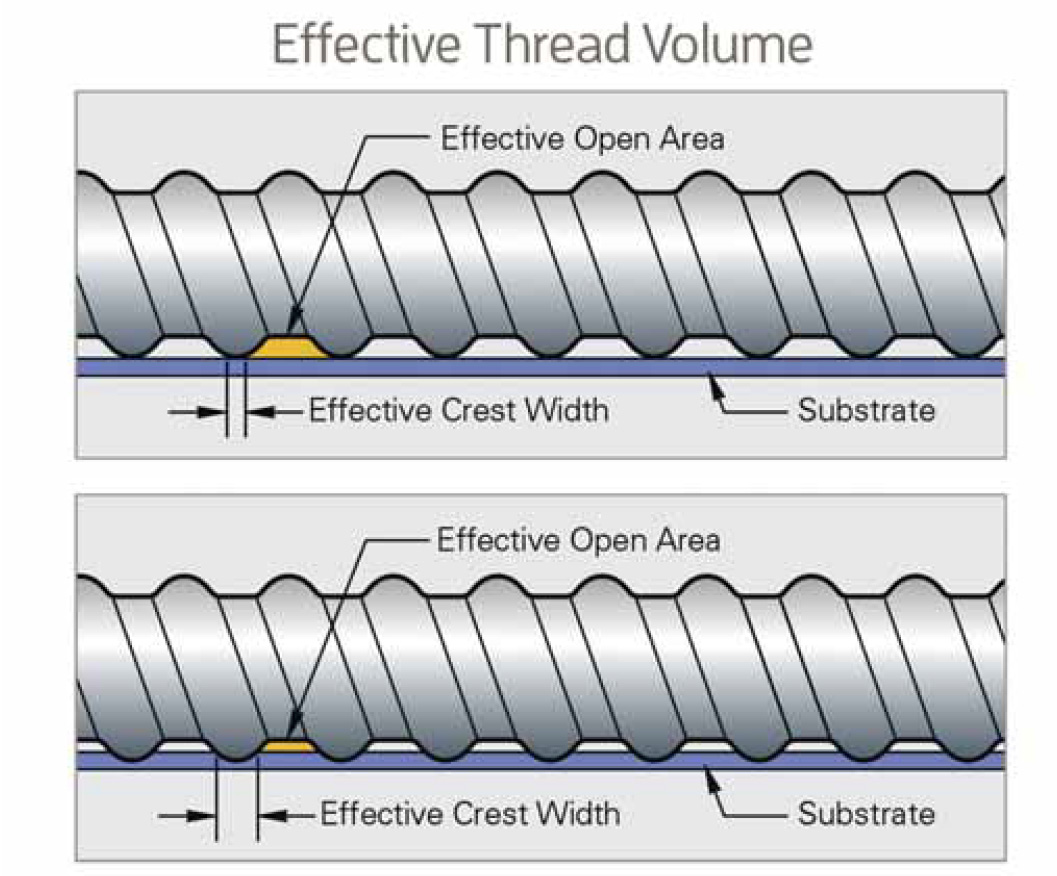
With grooved rod coating, coat weights are controlled volumetrically: The open area of the thread determines the volume of coating that remains after metering. As loading pressure increases, the threads of a grooved rod will penetrate the substrate further. As this occurs, the effective open area of the threads is reduced, which also reduces the amount of coating that can pass through the threads.
In addition to reduced coating volume, this effect also increases the effective width of the thread crests which can lead to rod lines and other coating defects.
Incorrect loading creates coating problems
Loading pressure that is too low or too high can cause several significant issues that impact your coating operations.
These include: difficulty controlling coat weights, machine direction coat weight variations, cross direction coat weight variations and web breaks due to over-saturation of the sheet.
Excess loading pressure can also lead to difficulties including: Machine direction lines (starvation streaks) in the coating; premature wear of costly backing rolls or transfer rolls; web breaks due to excessive tension on the sheet; and premature wear of the metering rod and rod holder.
When issues like these occur, the entire coating operation – and the bottom line – can be negatively affected. Production can come to a halt, inconsistencies in coatings can create waste, and the plant could be forced to replace backing rolls, metering rods, or rod holders much sooner than necessary.
Gauging Coat Weight Tuning
How much coat weight tuning should be done with load pressure? Based on our experience developing custom-engineered metering rod solutions for hundreds of paper mills and converting plants around the world, we advise against varying the loading pressure when using a single rod for a wide coat weight range. Attempting to do so will create major issues, including the ones discussed earlier in this article.
However, there is one exception to this rule: smooth rod coating. In smooth rod coating, coat weight is controlled with loading pressure and the rotational speed of the rod.
While there is no one-sizefits-all solution for calibrating loading pressure, these are smart steps you can take to avoid loading pressure that is too high or too low and the problems that come with these conditions.